
"I'm afraid that if you look at a thing
long enough, it loses all of its meaning."
-Andy Warhol
I have always enjoyed art in its many shapes and forms. If I had enough money, I would own every piece of art Andy Warhol touched, or maybe the rights to The Beatles songs, sorry Paul. There’s something so epic about another human being who can create a work of art out of nowhere. Who would have known a simple Pop Art painting of Campbell’s Tomato Soup would be worth so much today?
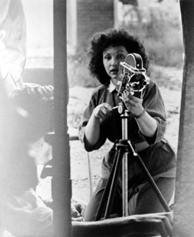
Art is how you interpret it. Art is meant to shock us, make us think; make us say “what just happened”? Deren does this to her audience with her films. Her metaphoric associations give us clues as to what she is trying to tell us, but nothing definite. In both films, she appears to be multiple characters. Her characters are always on a journey. A journey as the hero or the villain, we don’t quite know. A personal journey perhaps? She always personifies these characters; she is the only one who really knows what or whom she is trying to portray. “What is undeniable is that Meshes establishes key themes and cinematic innovations that Deren continued to explore throughout her career as an experimental filmmaker.” Senses of Cinema

Avant-garde is described as an artistic, experimental, ahead of its time, form of art. Today such filmmakers like David Lynch and Terry Gilliam, who’s Fear and Loathing in Las Vegas (1998), takes us on a wild ride through the life of Hunter S. Thompson, keep the image of Deren and others like her alive. It takes a person with a great imagination and a story to tell to create this type of movie.
Deren created her silent films with just her 16mm camera she purchased with the money her father had given her. She had a dream and a desire. She uses different angles, slow motion and her creative background to make these surrealist films challenge the viewer to think outside the box. I wonder what the movie industry would be like today if Deren were still alive today.
Souces:
Corrigan & White (2009), The Film Experience: An Introduction. (Chapter 9)


No comments:
Post a Comment